

Positives
- U.S. unemployment remained low at 4.4% in December
- Solid U.S. economic growth with Q3 GDP rising 4.3%
- Global stock & bond markets rallied, especially international stock & AI-focused tech companies
Risks and Concerns
- U.S. inflation at 2.7% CPI trailing year in December; still above the Federal Reserve’s target of 2.0%
- Tariffs currently causing market uncertainty & volatility Elevated equity valuations & market concentration
The Year in Review
Markets moved through periods of volatility this year but ultimately delivered strong performance across both stocks and bonds. The most notable disruption occurred in early April, when the U.S. president announced broad tariffs—referred to as “Liberation Day”—on several major trading partners. This triggered a sharp, four-day decline of roughly 12% in U.S. equities. In response, we trimmed exposure to smaller, more volatile domestic companies to help manage risk. Although some tariffs were implemented, the more expansive measures did not materialize, allowing markets to recover steadily in the months that followed.
2025 Major Index Total Returns
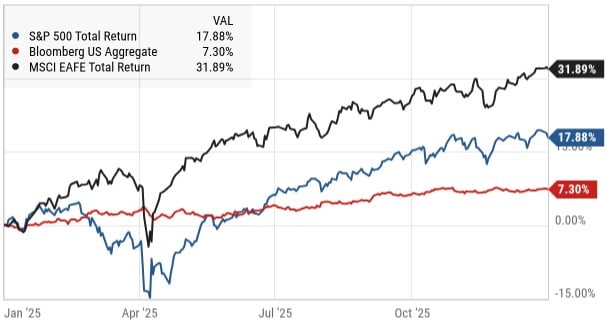
Global economic growth slowed to 2.4%, largely due to the impact of tariffs. In the U.S. however, the economy showed resilience: GDP growth picked up later in the year, even as the job market softened. The Federal Reserve responded to the cooling labor market by cutting interest rates three times in 2025, totaling 0.75%. Inflation remained elevated, influenced by trade restrictions and ongoing labor shortages.
Current Investment Strategy
During the fourth quarter, we made several portfolio adjustments focused on managing interest rate changes and improving tax efficiency.
Adjusting Bond Duration
We added an Ultra Short Duration Bond investment, shifting a portion of cash and money market holdings (roughly 2–5%, depending on portfolio). This ETF’s increased duration helps to increase yield as short-term interest rates decline.
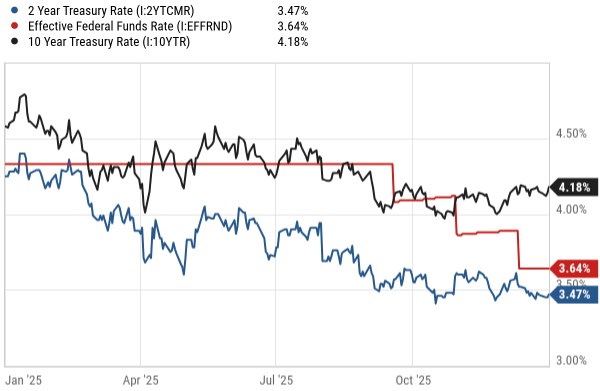
Although the Federal Reserve has begun lowering short-term interest rates, longer-term rates remain slightly elevated. This is because the Fed directly controls only short-term rates, while longer-term rates are shaped by bond-market expectations. Today’s higher long-term yields indicate that bond investors still anticipate inflation will stay higher than the Fed’s target.
As we saw last year—and continue to watch closely this year—increasing a portfolio’s bond duration can boost yields, but it also introduces more sensitivity to inflation. If inflation moves higher, long-term bonds face greater interest-rate risk, which can lead to rising yields and falling bond prices. Our focus remains on balancing these risks while seeking attractive opportunities across the fixed-income landscape. The following chart shows the widening gap between shorter and longer term interest rates (difference between 10 year and 2 year treasury rate) as the Fed cut rates throughout 2025.
2025 U.S. Interest Rates
Source: YCharts
Tax Smart Portfolio Moves
Our investment management team completed extensive tax loss harvesting to help offset earlier capital gains that arose from adjusting portfolios around tariff risks. In addition, we sold holdings that were expected to distribute unusually large capital gains.
Future Asset Allocation Changes and Considerations
Foreign stocks delivered meaningfully stronger returns than U.S. stocks in 2025. While currency movements—especially the weaker U.S. dollar—played a major role, the key takeaway is that global diversification added value to portfolios over the past year. A broadly diversified approach once again proved to be a winning formula.
Looking ahead, we are evaluating opportunities to increase allocations to international stocks and bonds, as well as sectors such as infrastructure, healthcare, and financials. Current policy developments and economic trends across different regions make these areas increasingly compelling.
We also plan to shift more money market holdings into longer-duration bond funds. This positioning helps support portfolio income as interest rates continue to adjust, and it provides a more durable source of yield compared to money markets alone.
Key Investment Takeaways
- 2025 was a great year for a globally diversified investment portfolio
- The Federal Reserve cut interest rates three times in the second half of 2025, and additional rate cuts are likely in 2026
- We modestly increased bond duration to help support income as interest rates fall
- Inflation remains above target, and the labor market may be weakening
- We are evaluating potential increases to select stock sectors and bond exposure
We will continue to monitor the market risks of this rapidly changing and volatile environment, frequently adjusting as needed with the goal of protecting and growing your investment portfolio. As always, please feel free to contact us with any questions or concerns.
Your Capital Advantage Team
