

Positives
- Low unemployment supports consumers. Unemployment remained at 4.2% in June
- Markets remain resilient. U.S. markets held up despite the Iran war and geopolitical uncertainty
- Hiring remains supportive. Continued hiring has supported consumer spending and growth
- AI continues to drive returns. AI enthusiasm remains a key support for technology stocks
- Corporate earnings remain strong. Earnings have supported equities despite interest rate and geopolitical risks
Risks and Concerns
- Interest rates are rising. So far, 25 countries have raised rates in 2026
- Equity valuations are high. AI boom has stretched the valuation of many large tech companies
- Inflation is rising. U.S. CPI inflation rose to 3.5% in June
- Slowing global economic growth. Global GDP likely to slow in 2026 and 2027
- Iran War. The Iran War is causing market volatility and energy price inflation
The Quarter in Review
Geopolitical and Energy Market Backdrop. The Iran War continued throughout the quarter, and its impact on global energy markets became the dominant factor shaping our investment strategy. The initial closure of the Strait of Hormuz created significant shipping disruptions, driving up oil prices and increasing costs for key supply-chain inputs such as helium and potash.
Cease-Fire Developments. On June 17th, the U.S. and Iran signed a Memorandum of Understanding (MOU) signaling an intent to negotiate an end to the war, establish a cease-fire, and reopen the Strait of Hormuz. However, the cease-fire proved short-lived. On July 7th, Iran struck container ships transiting the Strait, triggering renewed escalation between the U.S. and Iran that continued as of this writing on July 15th.
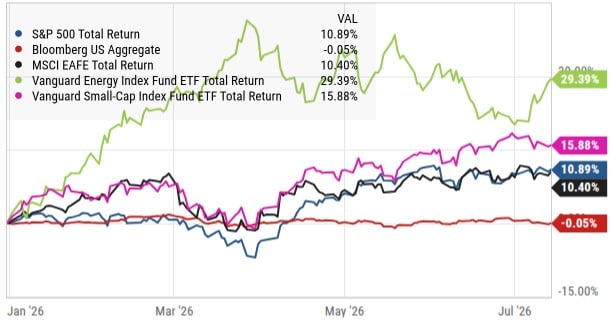
Market Impact. The following chart shows how major indexes have held up year to date. The temporary reopening of the Strait of Hormuz helped bring energy prices down from their highs, but the resumption of fighting kept energy prices elevated. As of July 15th, energy remained up nearly 30% for the year.
Major Index Performance YTD (through July 15)
Source: YCharts
Market Performance. U.S. small-cap equities performed well, likely aided by their lower exposure to international trade. U.S. and international large-cap equities delivered similar returns, each gaining just over 10%. By comparison, the U.S. aggregate bond market has been essentially flat. As you review your quarterly performance report, you will likely see that bond holdings meaningfully outperformed this broad bond benchmark.
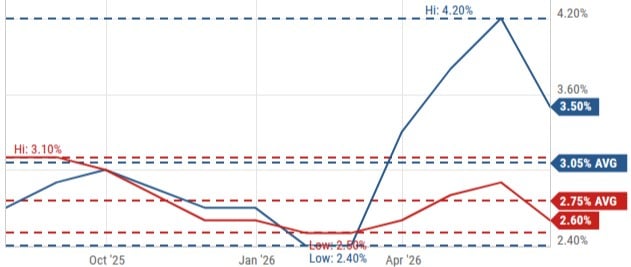
Economic Backdrop. Despite geopolitical and energy-market disruptions, the U.S. economy remained resilient. First quarter GDP grew 2.1%, inflation eased from its recent high of 4.2% to 3.5% in June, and unemployment remained low at 4.2%. The artificial intelligence boom also continued to support strong performance in the U.S. technology sector.
Current Investment Strategy
Inflation and Bond Portfolio Positioning. During the 2nd quarter, we adjusted bond portfolios in efforts to better protect against rising inflation and higher interest rates tied to the Iran war and disruption in global energy markets. The following chart compares two key inflation measures over the past year through July 15th: headline CPI, which reflects total consumer inflation, and core CPI, which excludes food and energy prices. Inflation recently peaked at 4.2% in May before easing to 3.5% in June, likely helped by the temporary reopening of the Strait of Hormuz.
- Headline CPI: The broadest measure of consumer inflation, including volatile categories such as food and energy.
- Core CPI: A narrower measure of consumer inflation that excludes food and energy, making it useful for identifying underlying inflation trends.
- Energy inflation: Changes in oil, gasoline, natural gas, and electricity prices; these prices can rise quickly when supply is disrupted.
- Wage and service inflation: Rising labor costs and higher prices for services such as housing, healthcare, travel, and insurance; this type of inflation can be slower to decline because it is tied to wages and longer-term contracts.
U.S. CPI Inflation Over the Past Year Through July 15th
(Red: Core CPI | Blue: Headline CPI)
Source: YCharts
Strategy Implication. We expect supply-chain disruption and elevated energy prices to keep inflation pressure higher for longer than markets anticipated earlier this year. In response, we reduced interest-rate risk by selling our longest-duration bond position, Vanguard Intermediate-Term Corporate Bond Index (VCIT). Longer-duration bonds are more sensitive to rising interest rates, so shortening duration helps to limit the potential impact if rates continue to move higher. We reinvested proceeds of this sale into iShares 0-5 Year TIPS Bond ETF (STIP) and/or iShares Treasury Floating Rate Bond ETF (TFLO). STIP provides exposure to short-term Treasury Inflation-Protected Securities (TIPS), which are designed to adjust with inflation. TFLO invests in floating-rate U.S. Treasury securities, whose interest payments reset frequently and can benefit as short-term rates rise.
Dividend Reinvestment Strategy. We are continuing to direct dividends to cash rather than automatically reinvesting to gain added flexibility to redeploy new cash where we see the strongest risk-adjusted opportunities. In the current environment, we are primarily using such cash flows to add to short-term bond positions, including STIP and TFLO, while preserving flexibility to adjust as market conditions evolve.
Asset Allocation Changes and Considerations
Federal Reserve Policy Expectations and Bond Duration. At the start of the year, markets expected the Federal Reserve to cut interest rates at least twice, with each cut anticipated to be 0.25%. At the time, inflation had declined to 2.4% and appeared to be cooling, while the labor market remained very strong. Since then, the Iran war has pushed inflation higher and shifted market expectations. Investors now increasingly expect the Fed’s next move to be an interest rate hike rather than a rate cut. CME FedWatch futures-market probabilities for the upcoming September Fed meeting now predict a 51.4% probability of a 0.25% rate hike and a 16.9% expected probability of a 0.50% rate hike (as of July 15th). This shift supports our decision to shorten bond portfolio duration, as shorter-duration bonds are generally less sensitive to rising interest rates.
Technology Concentration and Index Exposure. The next portfolio move we are evaluating relates to the U.S. technology rally driven by significant investment in artificial intelligence. While this rally may continue, we are increasingly mindful of the concentration risk within the largest technology companies, often referred to as the Magnificent 7. These companies now represent a large share of market-cap-weighted indexes such as the S&P 500 Index, which means weakness in a relatively small group of stocks could have an outsized impact on broad market returns. In response, we are researching whether to reduce exposure to traditional market-cap-weighted indexes and add strategies that provide broader diversification. This may include equal-weighted or revenue-weighted indexes, which could help reduce reliance on the largest technology companies while maintaining participation in the broader equity market.
Key Investment Takeaways
- Geopolitical risk remains elevated. The Iran war has increased uncertainty and volatility across global markets.
- Energy prices remain a key pressure point. Disruptions in and around the Strait of Hormuz have pushed energy prices higher and created additional supply-chain risk.
- Inflation pressure has increased. Rising energy prices are contributing to higher inflation and may keep price pressures elevated longer than previously expected.
- Interest-rate expectations have shifted. With inflation moving higher, markets increasingly expect the Federal Reserve to raise interest rates in 2026.
- Portfolio positioning has been adjusted. We have shortened bond portfolio duration to help reduce sensitivity to rising interest rates.
We will continue to monitor the market risks of this rapidly changing and volatile environment, frequently adjusting as needed with the goal of helping to protect and grow your investments. As always, please feel free to contact us with any questions or concerns.
